Quick Summary
The blogs provide practical guidance on lash extensions, covering both the first-time client experience and the choice between in-salon and mobile lash services. The first blog explains what clients can expect when getting natural lash extensions for the first time, including consultation, preparation, application, aftercare, maintenance, removal, and choosing a suitable lash studio. The second blog compares in-salon and mobile lash services, focusing on factors such as hygiene, environment, consistency, convenience, and service quality. Together, the content helps readers understand the lash extension process, evaluate their service options, and make informed decisions based on their beauty needs, comfort, and lifestyle.
What to Expect From Your First Natural Lash Extension Appointment
Booking your first set of natural lash extensions usually comes with a few questions running through your head. Will they look too dramatic? Will it hurt? What if you don’t like them? These are fair concerns, especially if the only extensions you’ve seen are the ultra-dramatic volume sets on social media. The good news is that natural lash extensions are specifically designed to enhance what you already have, not replace it, and a good first appointment should feel more like a consultation than a procedure.
This guide breaks down exactly what happens from the moment you book to the days after you leave the salon, so you can walk in feeling prepared instead of unsure.
What Makes Lash Extensions “Natural”
Not all lash extensions look the same, and the word “natural” refers to a specific style choice rather than a generic description. Natural lash extensions typically use a classic application, one extension applied to one natural lash, in lengths and curls that stay close to your own lash pattern. Compare that to volume sets, where several ultra-fine extensions are fanned onto a single natural lash for a fuller, more dramatic finish.
If your goal is a set that coworkers notice looks “good” without immediately clocking that you got extensions, classic natural lash extensions are almost always the right starting point. Lash artists can still add subtle length and curl; it just won’t read as heavy or false.
What Happens During Your First Consultation
A proper studio will not skip straight to application. Before any lashes go on, expect a short consultation where your lash artist looks at your natural lash density, growth pattern, and eye shape.
Questions You’ll Likely Be Asked
- How much length or drama are you comfortable with?
- Do you have any history of eye irritation or adhesive sensitivity?
- Do you wear contact lenses?
- What’s your daily routine like (swimming, sweating, makeup habits)?
This step matters more than most first-timers realize. It’s how the artist decides whether you need a lighter curl, a shorter length, or a more spaced-out mapping to keep the set looking like natural lash extensions rather than something heavier than intended.
Patch Testing
If you’ve never had lash adhesive near your eyes before, ask about a patch test 24–48 hours ahead of your appointment. Lash adhesives contain cyanoacrylate, and while reactions are uncommon, they can happen. The American Academy of Ophthalmology recommends a patch test for anyone trying a new eye-area product for the first time, and most reputable studios will offer this without you having to ask twice.
The Application Process, Step by Step
Once you’re settled in, here’s roughly what a natural lash extension appointment looks like from start to finish.
1. Cleansing and Prep
Your natural lashes are cleansed to remove any oil, makeup, or mascara residue. Adhesive doesn’t bond well to oily lashes, so this step directly affects how long your set will last.
2. Isolation and Mapping
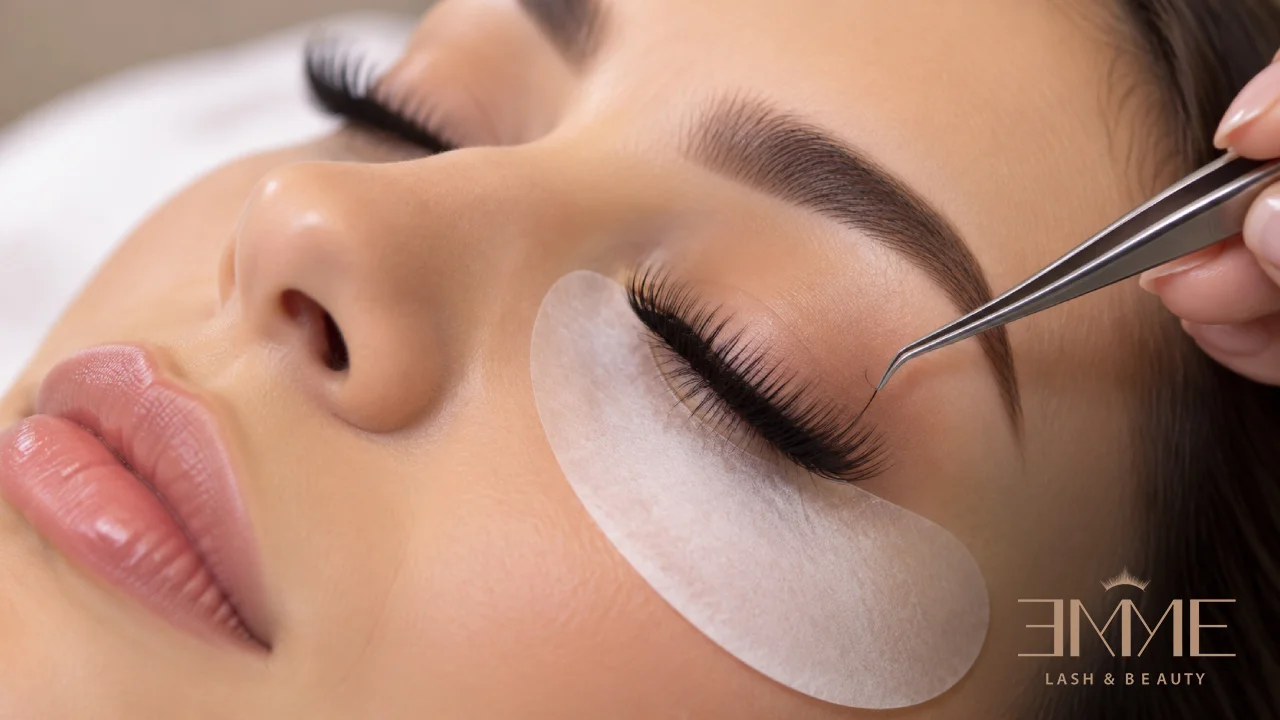
The artist isolates each lash using fine-tipped tweezers and maps out where shorter or slightly longer lengths will go, usually following your natural lash line rather than exaggerating it.
3. Application
Each extension is dipped in adhesive and placed on an isolated natural lash, close to but not touching the skin. For natural lash extensions, artists tend to use classic lengths (8–12mm) and a gentler curl, like a J or B curl, rather than the more dramatic C or D curls used in volume sets.
4. Curing
You’ll rest with your eyes closed for the remainder of the appointment, usually 90 to 150 minutes total, while a small fan or nano-mister is sometimes used to help the adhesive cure fully.
How to Prepare Before You Arrive
A few small habits before your appointment make a real difference in how your natural lash extensions turn out and how long they last:
- Arrive with clean lashes, no mascara or eye makeup.
- Avoid caffeine right before your appointment if you know it makes your eyes twitch or water, since you’ll need to keep them closed and still.
- Skip contact lenses if you’re not fully comfortable removing them, since some artists prefer lenses out during application.
- Bring reference photos if you have a specific look in mind, but be open to your artist adjusting it based on your actual lash health.
Aftercare in the First 48 Hours
The first two days set the tone for how well your extensions bond. Avoid water, steam, and sweat for at least the first 24 to 48 hours so the adhesive has time to fully cure. After that, oil-free cleansers and gentle daily brushing with a spoolie will keep your natural lash extensions looking fresh between fills.
If you’re also considering a lash lift and tint alongside extensions down the line, it’s worth reading up on whether lash lift and tint are safe to combine with other lash services before scheduling both close together.
How Long Do Natural Lash Extensions Last?
Most clients see individual extensions start shedding naturally within 2 to 3 weeks, following your own lash growth cycle. This is completely normal and not a sign of poor application. A fill appointment around the three-week mark keeps the set looking full without needing a completely new application. If you’re unsure whether you’re due for a fill or a fresh full set, this breakdown of refill versus a full new set explains how technicians usually make that call.
What If You Want to Remove Them Early?
Life happens, and sometimes clients want their lash extensions removed before they’d naturally shed. Trying to peel them off yourself is one of the fastest ways to damage your natural lashes underneath. If removal is on your mind, our guide on what actually dissolves lash adhesive safely walks through the difference between salon removal and at-home methods.
Budgeting for Your First Set
Pricing for natural lash extensions varies by studio, location, and the density of the set. As a general rule, classic natural sets are priced lower than volume or hybrid sets because they use fewer extensions per natural lash and less application time. If cost is a bigger factor for you than style, this comparison of cheap versus affordable lash extensions is worth reading before you book anywhere based on price alone. Cutting corners on adhesive quality or technician training is where “cheap” and “affordable” stop meaning the same thing, and where your natural lashes can actually get hurt.
Finding a Studio That Does Lash Extensions Naturally Well
Not every lash studio specializes in the subtler, classic application that natural lash extensions require; some are built around dramatic volume work instead. At Emme Lash Bar, our studios across Brookline, Cambridge, Dedham, Newton, South Boston, and Burlington regularly work with first-time clients who specifically ask for a natural, everyday-wearable look, and our consultations are built around getting that ratio of length, curl, and density right the first time.
Adhesive safety is also worth understanding regardless of where you book. The FDA’s guidance on cosmetic adhesives is a useful reference if you want to understand what’s actually in the products being used near your eyes.
Final Thoughts
Your first appointment for natural lash extensions doesn’t need to be intimidating once you know what’s actually happening at each stage, from consultation to curing to aftercare. The most important thing is choosing a studio and lash artist who ask questions before they pick up the tweezers, since that consultation is really what decides whether your set looks natural or overdone.
If you’re ready to book your first appointment, our team at Emme Lash Bar is happy to walk you through length, curl, and style options during your consultation, with no pressure to commit to anything more dramatic than you’re comfortable with.
Frequently Asked Questions
1. What are natural lash extensions?
They’re individually applied synthetic or silk lashes, one extension per natural lash, in lengths and curls close to your own lash pattern for a subtle, everyday finish.
2. Do natural lash extensions look fake?
Not when applied correctly. Classic application with lighter curls and shorter lengths is specifically designed to blend with your natural lash line.
3. How long does a first appointment take?
Most first-time natural lash extension appointments take 90 to 150 minutes, depending on lash density and desired look.
4. Do natural lash extensions hurt?
No. Application shouldn’t cause pain. Mild watering or sensitivity can happen if you have an adhesive allergy, which is why patch testing matters.
5. Can I wear mascara with natural lash extensions?
It’s not recommended. Most mascaras contain oils that break down the adhesive bond and shorten how long your set lasts.
6. How soon can I get my lashes wet after the appointment?
Wait at least 24 to 48 hours before water, steam, or sweat exposure to let the adhesive fully cure.
7. How often do I need a fill?
Around every 2 to 3 weeks, following your natural lash shedding cycle.
8. Are natural lash extensions safe for sensitive eyes?
Generally yes, when a patch test is done beforehand and a qualified technician uses quality adhesive.
9. What’s the difference between classic and natural lash extensions?
They’re often the same thing. “Classic” refers to the one-to-one application technique, while “natural” describes the resulting look.
10. Can I switch from natural to a fuller look later?
Yes. Many clients start with a natural set and add volume in later fills once they’re comfortable with the maintenance routine.
